
Area Codes Serving Mississippi
Five codes are in service across Mississippi right now: 228, 471, 601, 662, and 769. The oldest of them is 601, which the original 1947 numbering plan handed to the state and which covered every phone in Mississippi for about half a century. The other four all came out of 601, either by carving off a piece of the map or by stacking a second code on ground that already had one. The Gulf Coast left first, the north left second, and the two remaining regions each picked up an overlay partner later on.
Geography still tells you a lot here, but not everything. A 228 number almost certainly belongs to the three coastal counties. A 662 or 471 number belongs somewhere north of the middle of the state. A 601 or 769 number sits in the middle or the south, Jackson included. What geography cannot tell you is which carrier holds the number today, because people keep their numbers when they move and when they switch providers.
| Area Code | Coverage | Year Assigned | Overlay Status |
|---|---|---|---|
| 601 | Jackson, Hattiesburg, Meridian, Natchez, Vicksburg, Laurel, McComb, Brookhaven and the rest of central and southern Mississippi | 1947 | Original code, overlaid by 769 |
| 769 | The same central and southern ground as 601, with no separate boundary | 2005 | Overlay on 601 |
| 228 | Gulfport, Biloxi, Pascagoula, Bay St. Louis, Ocean Springs, Long Beach, Moss Point and the counties of Hancock, Harrison, and Jackson | 1997 | Split from 601, no overlay |
| 662 | Southaven, Horn Lake, Hernando, Tupelo, Oxford, Starkville, Columbus, Corinth, Greenville, Greenwood and north Mississippi | 1999 | Split from 601, overlaid by 471 |
| 471 | The same north Mississippi ground as 662, with no separate boundary | 2026 | Overlay on 662 |
Note: Four of the five codes trace straight back to 601, so an old Mississippi number and a new one can sit in the same town under different prefixes.
Mississippi Area Code Coverage by Region
The cleanest way to read a Mississippi area code is by region rather than by city. Three regions exist. The coast is one, the north is one, and everything else is the third. Two of those regions have a pair of codes because of an overlay, which means a street in Tupelo or a street in Jackson can hold numbers under either code in the pair. Neighbors do not get sorted by area code in an overlay. They share the same ground and the same local calling area.
- Gulf Coast - 228 covers Gulfport, Biloxi, Pascagoula, Ocean Springs, Bay St. Louis, Long Beach, and Moss Point, plus the rest of Hancock, Harrison, and Jackson counties.
- Jackson metro - 601 and 769 both serve Jackson, Clinton, Pearl, Brandon, Madison, and Ridgeland.
- Southern and southwest Mississippi - 601 and 769 cover Hattiesburg, Laurel, Natchez, Brookhaven, and McComb.
- East central Mississippi - 601 and 769 reach Meridian and the towns around it, with Vicksburg to the west on the same pair.
- DeSoto County and the Memphis edge - 662 and 471 serve Southaven, Horn Lake, and Hernando.
- Northeast Mississippi and the Delta - 662 and 471 cover Tupelo, Oxford, Starkville, Columbus, Corinth, Greenville, and Greenwood.
Those pairs matter when someone gives you a number over the phone. In the north and in the middle of the state, hearing 471 or 769 instead of the older code is normal and says nothing about where the person lives.
Mississippi Area Code Overlays and Splits
Mississippi has used both methods of adding numbers, which is unusual and is the main reason the state looks confusing on a code map. The 1997 and 1999 changes were splits. A chunk of the map was cut away from 601 and handed a fresh code, and everybody inside that chunk got a new area code whether they wanted one or not. The 2005 and 2026 changes were overlays. Nothing was cut. A second code was simply laid over the same territory and handed out to new lines from that point forward.
Splits are cleaner to read on a map and much harder on residents. Overlays are the opposite, easy on residents and messy to read, because a single town can hold two codes at once.
- Overlay
- A second area code added to the same geography. Everyone keeps the number they already have. Local calls take ten digits, since seven digits would be ambiguous across two codes.
- Split
- The old area code keeps part of the map and the new one takes the rest. People inside the new region change their area code.
- Permissive Dialing
- The window during an overlay rollout when both the old and the new dialing patterns still connect, so people can adjust before the cutover.
- NPA
- Numbering Plan Area, which is the formal name for the three-digit area code itself.
Dialing Rules Across Mississippi
The rule is not the same everywhere in Mississippi, and that trips up people who move within the state. In the 601 and 769 region, local calls take ten digits and have since the overlay arrived in 2005. In the 662 and 471 region, local calls also take ten digits, toll calls take 1 plus ten digits, and operator calls take 0 plus ten digits. That plan comes straight from the NANPA planning letter written for the overlay. The 662 region actually moved to ten digits back in 2021, ahead of the overlay, because of the national switch to 988 for crisis calls.
Important: Ten digits is the safe habit anywhere in Mississippi. Seven-digit dialing only survives in the 228 coastal region, and only where the carrier still allows it.
Area code 228 is the exception because it is a split rather than an overlay, so the Gulf Coast holds one code with no partner sharing the same ground. Legacy seven-digit local calls can still go through there depending on the carrier and the calling plan. Mobile phones ignore all of this and want ten digits everywhere. The rest of the dialing picture, including the short service codes and the star codes, is laid out on the Mississippi phone codes page.
471, the Newest Mississippi Area Code
The 471 code is the only recent change to the Mississippi area code map, and it only affects the north. The Mississippi Public Service Commission approved it on June 13, 2024 in Docket 2023-AD-0149 as an all-services distributed overlay on 662. NANPA followed with Planning Letter 627 on August 19, 2024, and the code went into service on January 30, 2026. Network preparation and public education ran from April 30, 2025 until the in-service date, and carriers could start ordering 471 prefixes on November 25, 2025.
The Public Service Commission overlay page is the official Mississippi source for the 471 rollout.
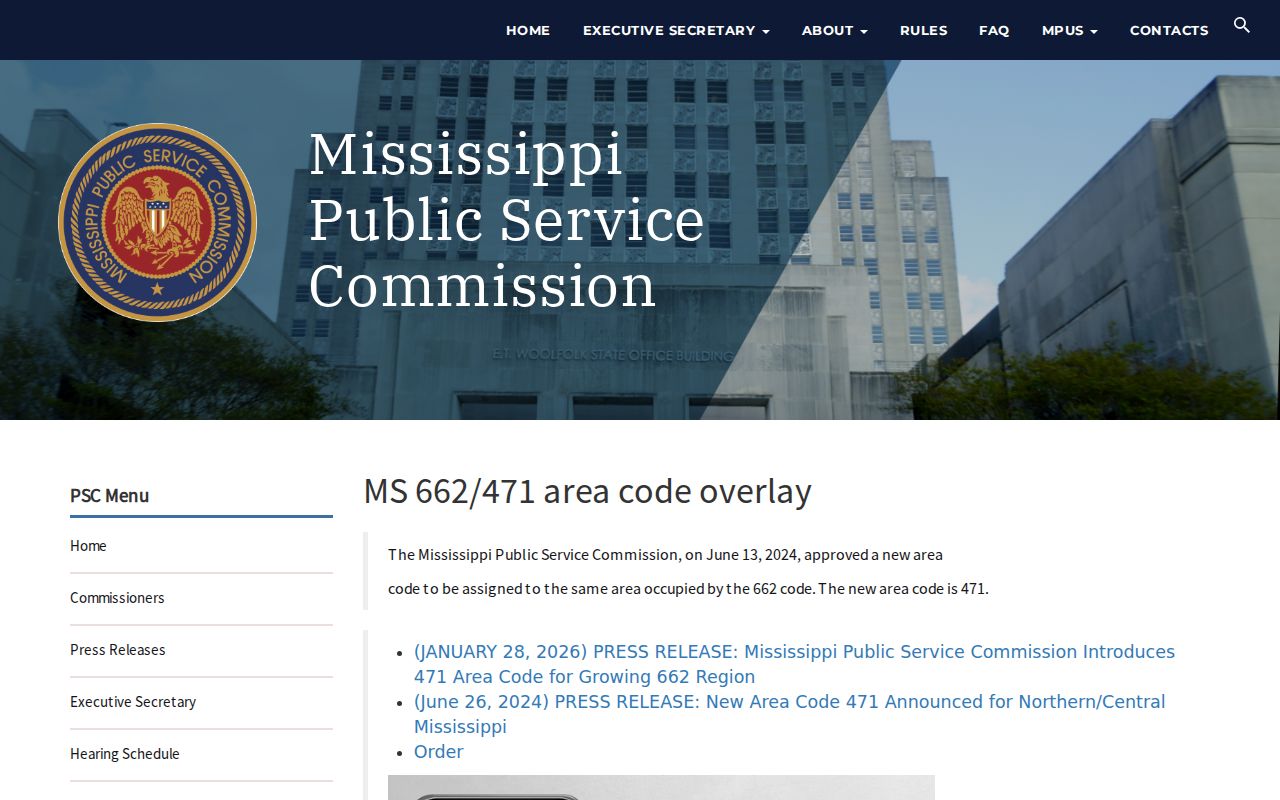
The commission posts the order and the press releases behind the change on that same page, including the January 28, 2026 announcement.
One detail matters for anyone holding a 662 number. Nothing changed for them. New 471 prefixes only become available once the assignable prefixes in 662 are used up, so 471 numbers will show up gradually rather than all at once. A resident who orders a new line or an extra line in north Mississippi is the person most likely to be handed one. Planning Letter 627 also set aside 471-471-0471 as a temporary test number between October 2025 and February 2026, which is worth knowing only as a piece of history now that the window has closed.
How Mississippi Area Codes Changed
The whole story runs about eighty years. Mississippi started with one code and ended up with five, and every step was driven by running out of numbers rather than by any change in the map itself. Fax machines and pagers ate into the supply first, then second household lines, then wireless service, then blocks of business numbers, and eventually internet phone service. Each wave pushed the state closer to the next relief plan.
| Year | Event |
|---|---|
| 1947 | 601 assigned to Mississippi in the original North American Numbering Plan, covering the whole state |
| 1997 | 228 split away from 601 for the Gulf Coast |
| 1999 | 662 split away from 601 for northern Mississippi |
| 2005 | 769 added as an overlay on 601, bringing ten-digit local dialing to the center and south |
| 2021 | 662 moved to ten-digit dialing during the national 988 transition |
| 2024 | Mississippi PSC approved 471 as an overlay on 662, and NANPA issued Planning Letter 627 |
| 2026 | 471 entered service on January 30 for the north Mississippi region |
Phone service itself is much older than any of this. The first exchange in the state opened in Vicksburg on January 10, 1881, at 102 1/2 North Washington Street, run by the Louisiana Telephone Company. Mississippi later sat inside the Bell System, served by Southern Bell until 1968, then South Central Bell, then BellSouth, which AT&T bought in 2006.
Note: The two splits changed people's area codes, while the two overlays left every existing Mississippi number exactly as it was.
Exchange Prefixes Under Mississippi Area Codes
Under every Mississippi area code sits a layer of three-digit exchange prefixes, written as the NXX in the NPA-NXX-XXXX format. Those prefixes were built around rate centers, which are the billing areas carriers use to decide what counts as a local call. Gulf Coast rate centers sit under 228 and cover places like Gulfport, Biloxi, Pascagoula, Ocean Springs, Bay St. Louis, and Moss Point. Central and southern rate centers sit under 601 and 769 and cover the Jackson metro along with Hattiesburg, Meridian, Natchez, Vicksburg, and the towns around them. Northern rate centers sit under 662 and 471 and include Tupelo, Oxford, Starkville, Columbus, Corinth, Greenville, and Greenwood.
Prefix lists go stale fast. Planning Letter 627 says as much and points readers to NANPA, the iconectiv LERG Routing Guide, or the NPA-NXX Activity Guide for current data. The LERG is a licensed product rather than a free public lookup, which is why no honest site publishes a complete live Mississippi prefix table.
Future Area Codes for Mississippi
No further relief is on the books for Mississippi in the current planning material. The 471 overlay was the answer for north Mississippi, and it has enough headroom to last well past its first year. The Gulf Coast still runs on a single code with no overlay partner, and the central and southern region has had 769 available since 2005. Any future change would follow the same path this one did, starting with a NANPA exhaust projection.
The Public Service Commission is the body that approves relief in Mississippi, and NANPA handles the technical planning and publishes the planning letter that sets the schedule. Residents do not have to do anything when an overlay arrives. Nobody renumbers, nobody reprograms a phone, and the only visible change is the dialing habit and the appearance of an unfamiliar code on new lines.
NANPA publishes relief planning and every planning letter at nanpa.com, which is where a Mississippi change would surface first.
Planning letters are dry reading, but they carry the exact dates that news coverage usually rounds off.
Checking a Mississippi Area Code
Two checks handle almost every question about a strange code. The first is whether the code exists at all, and the second is which state it belongs to. NANPA keeps the map that answers both. If a caller claims to be a Mississippi office and the code is not one of the five in service here, that is a strong sign the call is not what it says it is. The catch is that spoofing works the other way too, so a real Mississippi code proves nothing on its own.
The NANPA area code map portal lets you pick a state and see every code assigned to it.
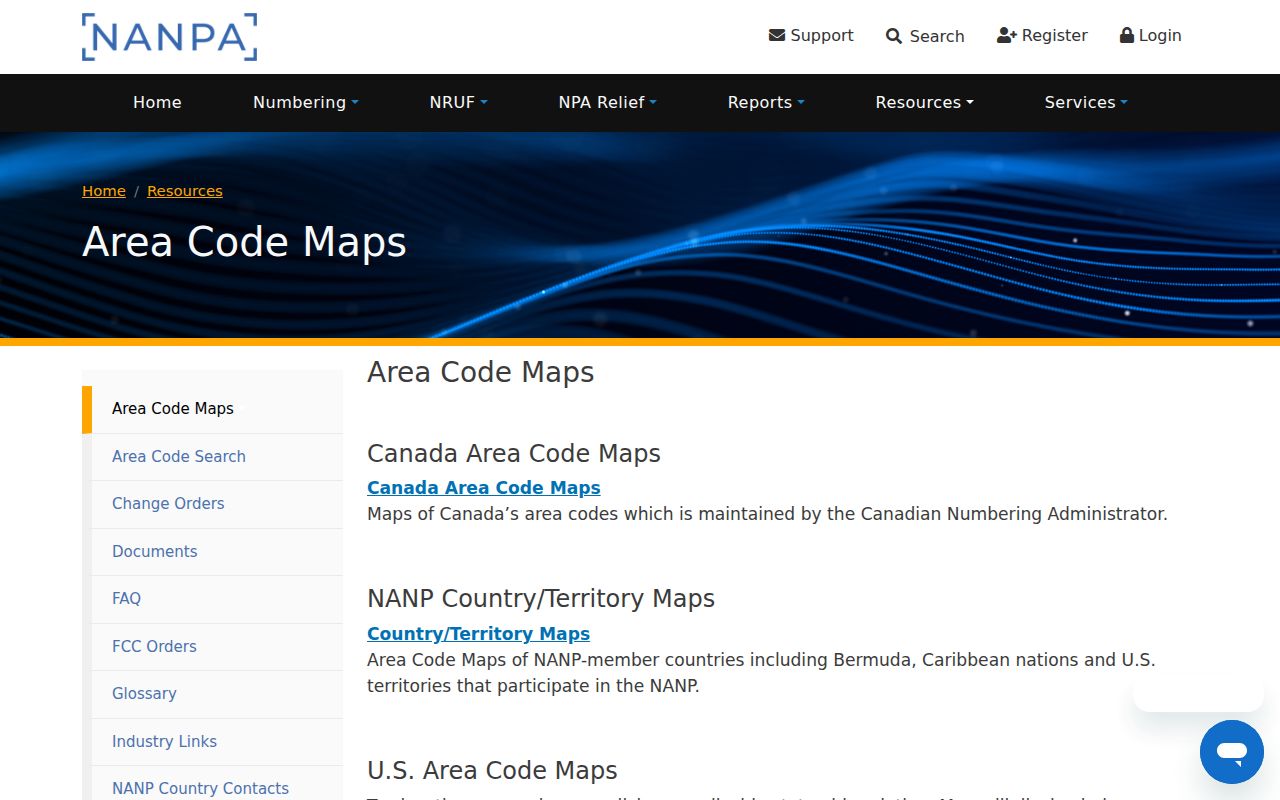
Pulling up Mississippi there returns the same five codes that fill the coverage table.
When the caller claims to be a specific agency, skip the code entirely and compare the number against the office directory instead. Looking up a Mississippi number that way is covered on the Mississippi phone numbers page. The FCC also publishes consumer guidance on ten-digit dialing and on the short service codes, which is useful background when a dialing rule changes.